
International M.A. in Education

Why This Program Matters

Global & Inclusive

Global & Inclusive

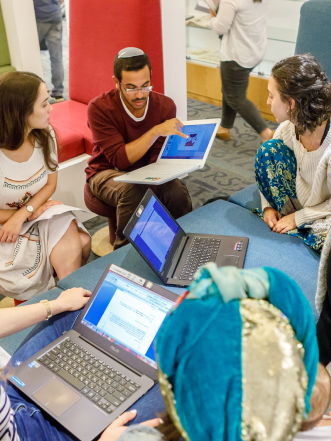
Educators from across the world (Jewish and non-Jewish) shape Jewish learning - united in mission.

Flexible Hybrid Format

Flexible Hybrid Format

Four asynchronous online semesters, immersive winter Zoom sessions, and an intensive summer seminar in Israel.

Personal Mentorship & Support

Personal Mentorship & Support

Constant individual attention from coordinators and faculty - a true educational partnership.

Scholarship Opportunities

Scholarship Opportunities

Generous financial aid for academic excellence, professional experience, and mid-career fellows.

More About The Program

Choose Your Focus

Identity & Culture

Identity & Culture

Delve into Jewish thought, heritage, and cultural identity in global contexts.

Innovation & Entrepreneurship

Education Management & Entrepreneurship (specialization in the process of approval)

Learn to design, lead, and transform educational programs in Jewish communities.

Teaching Hebrew as a Second Language

Teaching Hebrew as a Second
Language New Specialization

Equip yourself to teach Hebrew around the world - integrating language pedagogy with cultural immersion.

Discover More

Program In Numbers

90+

Students

30+

Countries

3

Tracks

250

Graduates

Explore Our Global Impact

Your Journey Starts Here

1 | Review Requirements

Check eligibility and program requirements.

Schedule a Call

2 | Schedule a Call

Speak with our admissions team for guidance.

Apply Online

3 | Apply Online

Submit your application and required documents.

After You Apply

4 | After You Apply

Learn about timelines, decisions, and next steps.

View RequirementsApply now

From Our Blog

Crossing Fields: Bridging Language Didactics and Jewish Education

chiara_lipp


chiara_lippWhen I received the approval for my presentation at the Hebrew University of Jerusalem as part of the conference Identity and Belonging in Contemporary Jewish Education, my excitement was accompanied by a familiar feeling: impostor syndrome. What if my academic background wasn’t enough to fall into the field of Jewish education? What if my research topic did not blend in with the other contributions? My doctoral thesis focuses on children’s perspectives regarding the language policy of their own schools. Although this research is situated within a Jewish primary school, and although I have long been involved in youth and children’s programs in a variety of Jewish communities in Germany, my academic background originally lies elsewhere: 

I am a trained primary school teacher specialized in German and English language education. 

However, during my research, particularly throughout the data collection, I realized that my background was not an obstacle. On the contrary, the methods I adapted from the field of language didactics and applied linguistics opened up new possibilities for research within Jewish educational contexts. 

Anyone conducting research in Jewish education will inevitably encounter questions of language. While attention is often directed first toward Hebrew, as well as other Jewish languages such as Yiddish or Ladino, the heritage languages spoken by many children in the Diaspora must also be taken into consideration. This has been discussed, among others, within the work of scholars such as Sharon Avni, Mila Schwartz, and Elana Shohamy. 

Primary language education and didactics offer a wide range of methodological approaches that can help make the significance and structure of languages spoken by the children themselves visible and enable age-appropriate discussions of complex linguistic topics. One example is the use of language portraits; a method often connected to Ingrid Gogolin, Ursula Neumann or Hans-Jürgen Krumm. In this activity, children are invited to draw or write “their” languages within the outline of a human silhouette, allowing researchers or educators to explore which languages are associated with the child’s heart, mind, legs or other parts of their body. Other concepts include work with language biographies or the use of (multilingual) picture books as communication starters for discussions between children. Such methods could encourage children to reflect on questions such as: Where does Hebrew belong within my everyday life and how do I feel about it? Where does my heritage or family language belong? What connects these languages and what distinguishes them? 

The fields of language didactics and applied linguistics also provide methods that enable children to engage not only with their own linguistic repertoires but also with the (Jewish) linguistic environments that surround them. One particularly interesting approach is the use of linguistic landscape, which can be applied also in Jewish communities, schools, summer camps and other Jewish spaces. 

Linguistic landscape research examines the visibility and use of language in public spaces, including signs, posters, notices, and official documents. Linguistic signs are systematically photographed, documented, and analyzed in order to gain insights into multilingualism, linguistic identities and power relations, shown through for example the connections between different languages or the spaces and frequency in which they appear. 

A related approach, known as the virtual linguistic landscape, focuses on the representation of language in digital environments such as websites. In previous research, this method allowed me to deepen my understanding of the official language policies of Jewish primary schools in Germany. It provided initial insights into how these institutions understand and present themselves, revealing a strong emphasis on Hebrew alongside an international orientation represented using the English language. 

Such methods also have the potential to start discussions about the very concept of language itself. This is especially relevant in the context of diaspora, where linguistic practices often involve language mixing or code switching rather than clearly separated languages. 

All these examples show why I deeply cherish working and researching in the field of Jewish education and why some of us might occasionally struggle with impostor syndrome. Jewish education relies on and benefits from interdisciplinarity, on overlaps and differences, on learning from and with one another. It is shaped by the combination and insights of so many fields such as history, religion, language, pedagogy, and many others. 

Ultimately, Jewish education resembles Judaism itself: diverse, vibrant, and dynamic. Our way of approaching research should therefore continue to embrace innovation and interdisciplinary collaborations. 

The Responsibility to Repair

bruno_byn

bruno_byn

More than four years ago, I began volunteering with Beit Halochem Argentina. At the time, I was 21 years old and halfway through my Sociology degree at the University of Buenos Aires, looking for new horizons, opportunities, and causes that could enrich my education and connect it with my interests. After two and a half years as a volunteer, and having already graduated, I became the organization’s coordinator in Argentina.

Beit Halochem is the organization responsible for rehabilitating and helping rebuild the lives and dreams of wounded IDF veterans and civilian victims of terrorism in Israel. It was founded in 1949 to assist the more than 3,000 people wounded in the War of Independence. Today, it operates four centers in Jerusalem, Tel Aviv, Haifa, and Beersheba, and is preparing to open a fifth center in Ashdod. Before October 7, 2023, it had 50,000 members from across Israel’s wars; today, that number has risen to more than 70,000. A further challenge is that, before the war, most members were older, generally aged 40 and above. Today, the newly wounded joining its ranks are young people between the ages of 21 and 25, who experienced the beginning of the most recent war as soldiers completing their mandatory service or as young reservists.

Over the years, through my work with the organization, I came to understand how wounded veterans are rehabilitated, what their needs are, and which new challenges they face after being injured. Beit Halochem offers all kinds of physical therapy, hydrotherapy, group treatments for coping with post-traumatic stress disorder, educational scholarships, social and recreational activities, spaces for families and children, trips, and much more. It truly becomes a second home for those who gave everything for the State of Israel and must now cope with the devastating consequences of war. It is a place where Jews around the world can give something back to those who have given so much for us.

The organization is supported by donations from Beit Halochem friends’ associations around the world, including Argentina, Brazil, Canada, the United States, and France, as well as by assistance from the Ministry of Defense and a symbolic monthly fee paid by each wounded member after a certain period of membership. In Argentina, we work to raise awareness of a cause that is extremely important, yet often little known, and to raise funds that are sent to Israel and used to improve infrastructure, services, and other areas.

Every year, we receive delegations of wounded veterans in Argentina. They arrive with heroic stories and a desire to share their experiences. During these visits, we accompany them to communities, schools, social clubs, and private events, where these heroes—most of whom have visible physical injuries—feel comfortable telling their stories and describing their rehabilitation. Through these encounters, I gradually came to understand that physical injuries can be extremely serious, such as the loss of a limb or mobility in one leg, but that psychological wounds are often the hardest to live with on a daily basis.

In January 2026, we had the privilege and honor of receiving a larger delegation than usual. Sixteen Beit Halochem members arrived in Argentina, including thirteen disabled veterans and three members of the organization’s staff. All the veterans were suffering from severe post-traumatic stress disorder, while their physical injuries were relatively minor. In light of this, we decided to organize a recreational and therapeutic trip that would allow them to spend their time in Argentina enjoying themselves and exploring the country, rather than giving talks that could cause considerable mental fatigue and emotional strain.

With sixteen people, nine days ahead of us, and an extremely demanding itinerary, we set off for Bariloche. In my role as coordinator, I accompanied the group at all times and got to know each of the young participants individually, along with their stories and interests. During our three days in Bariloche, we went kayaking, horseback riding, and trekking; we swam in the lakes, ate, laughed, and forgot about the war for a few moments.

Iguazú provided another extraordinary opportunity for enjoyment. We visited the waterfalls, while the group—more united than ever and displaying an undeniable sense of family—shared dinners, outings, and laughter everywhere we went, making the trip a complete success.

Buenos Aires was the perfect conclusion to the journey. We visited the Colón Theatre, explored the city’s emblematic neighborhoods, went to AMIA, had lunch with the Israeli ambassador, and joined the Lamroth Hakol community for a Shabbat dinner to share the end of the trip together. These were moments of new, genuine, and lasting connections.

The entire trip proved to be a healing experience, with the concepts of Tikkun and Arevut always present. The idea of repair after rupture—both in the world and in our brothers and sisters who have given so much for us—never left my mind. The mutual responsibility we have as Jews toward other Jews around the world, wherever they may live, is rooted in an enduring interconnectedness that leads communities to support those who need them most.

I will never forget a conversation I had with Idan, a 32-year-old wounded veteran who has lived with post-traumatic stress disorder since Operation Protective Edge in 2014. His words deeply moved me when he explained that visiting the destination was not the most important part of the trip, nor was it his main objective. For him, the true importance lay in sharing experiences with people who had been through the same things he had and who, with Beit Halochem’s support, could come together in a safe and nonjudgmental environment, whether in Bariloche or anywhere else in the world. What moved him was the effort we had made to create the best possible conditions for that healing encounter.

In conclusion, I continue to recognize the importance of educating people to take responsibility, to act, and to become individuals who are committed to their communities, willing to dedicate some of their time to those who need it most, and prepared to help repair whatever can be repaired.


--


Bruno is a student in the International MA in Jewish Education.

AI Chatbots as Gateways to Jewish Learning?

ehud

ehud


Designing New Paths into Text, Identity, and Meaning


My engagement with AI in education did not begin with excitement about a new technology, but with concern about the threat it poses to teaching and learning. In a large education course I recently taught, I began reading students’ final papers and quickly realized that many had been produced by AI. The papers were fluent, well organized, and often excellent. But something essential was missing: the students’ own voices. In some cases, I was not even sure the student whose name appeared on the paper fully understood what they had submitted.


This is not a crisis confined to my classroom. It is a challenge confronting universities, schools, and educational institutions more broadly. AI does not simply help students write; in many cases, it takes their place. When that happens, it threatens a central purpose of humanistic education: creating an interpretive space in which students encounter texts, ideas, and fundamental human questions in their own voice.


In Jewish education, this concern is even sharper. The encounter with Jewish texts and traditions is never merely intellectual. It touches identity, values, belonging, memory, and community. If AI performs the work of interpretation for the learner, the assignment may be completed, but the educational process itself is weakened, perhaps even emptied of meaning.


There is no magic solution, and no single correct response. One powerful approach, embraced by Haredi society, is technological avoidance. In many Haredi communities and yeshivot, the internet is deliberately kept at a distance in order to preserve a sustained human encounter with Jewish texts and learning. While I see this as a serious educational strategy, it also suggests that Judaism is best protected by separating it from modern life, a premise that pluralistic Jewish education cannot fully embrace.


As educators, we need to think not only about protecting learning from AI, but also about how this technology might serve the purposes of Jewish education. If AI threatens to replace the learner, one task is to ask how it might instead bring learners back into conversation, interpretation, identity, and meaning construction.


This post focuses on one experimental initiative that took precisely this path. Rather than avoiding AI, it asked how Jewish educators might use it to open new pedagogical possibilities through chatbots.


Unlike an open-ended exchange with a general AI tool, an educational chatbot is an AI conversation whose aims, patterns of interaction, knowledge base, tone, and boundaries are defined in advance. Precisely for that reason, chatbots can be shaped to serve a particular pedagogy. The educator does not simply adopt AI. The educator translates an educational challenge, a set of values, and an imagined learning process into a technological tool.


This was the premise of an experimental initiative in an M.A. course in Jewish education. The participants were educators working across formal and informal Jewish educational settings: schools in Israel, youth movements, community institutions, teacher education, Bar and Bat Mitzvah preparation, and Jewish education in the Diaspora. Their final assignment was not a traditional academic paper. Instead, they were asked to design a chatbot for their own educational context and explain the educational thinking behind it.


After the course ended, I interviewed ten of these educators about the chatbots they had created. I wanted to understand not only what they built, but how they thought as educators while building it. The study was guided by three questions: How do Jewish educators define the goals and uses of chatbots in their educational contexts? How do they translate pedagogical and professional ideas into the design of a chatbot? And what possibilities and challenges do they identify when thinking about the integration of chatbots into Jewish education?


The results were strikingly varied. Sarah, an educator in a Reform community, designed a chatbot to help visitors move beyond listening to a lecture and enter a deeper conversation about Jewish identity, values, and communal life. Avraham, who works in secular-cultural Jewish education, created a chatbot to help families and communities design a meaningful Shabbat experience. Rivka, a high school social sciences teacher, built a chatbot to accompany students through the stages of an inquiry project.


Rachel, an educator in a youth movement, designed a chatbot to help guides rethink educational programs for trips to Poland, moving away from fixed messages and toward moral dialogue. Leah, who works in teacher education, created a simulation in which teachers could practice responding to a politically oppositional student in conversations about Judaism, democracy, and citizenship. Eliyahu, a Bar and Bat Mitzvah educator, built a chatbot that allowed students to “encounter” Regina Jonas, the first woman ordained as a Reform rabbi. In all these cases, necessity was the mother of invention: building a chatbot began by exposing the concrete educational challenges each educator faced.


What connected these projects was not the technology itself, but the process behind it. The educators began by identifying a difficulty in their own work: too much frontal transmission, too little dialogue, limited time for individual guidance, the challenge of leading value-laden conversations, or the need to make an institution’s pedagogical language accessible to many users. Only then did they ask how a chatbot might respond.


In this sense, chatbot design became a process of pedagogical translation. The educators had to define what kind of conversation they wanted to create, what sources the chatbot should draw on, what questions it should ask, what persona it should adopt, and where its limits should be. Abstract educational commitments such as dialogue, interpretation, identity, reflection, and value clarification had to be turned into concrete instructions, conversational moves, and forms of interaction.


Ruth captured the professional value of this process when she explained that “the chatbot forces you to deal with these questions.” It also strengthened the educators’ pedagogical content knowledge: they had to clarify goals, define key concepts, imagine the desired interaction with learners, and then test and refine the chatbot iteratively.


The educators also identified concrete advantages in working with chatbots. Chatbots can accompany learners beyond the limited time of the classroom, offer step-by-step guidance, and give students a preliminary foundation before meeting with the teacher. They can also create simulation spaces for difficult conversations.


Leah’s chatbot, for example, allowed teachers to rehearse a politically charged classroom exchange before facing it in real time. As she explained, “the simulation [of teachers interacting with the chatbot of an oppositional student] was very significant for everyone, because they were able to observe something happening and ask themselves: wait, how would I answer this student? What do I actually have to say to him? What are the things I am thinking about, and what could help me? And how does one manage such a conversation?”


In this way, the chatbot does not replace the educator’s work, but changes the division of labor: it supports preparation, practice, and scaffolding, while allowing the educator to focus on moments that require human judgment, sensitivity, and presence.


At the same time, the educators were careful not to confuse technological interaction with full educational dialogue. Eliyahu, reflecting on a chatbot that simulated a historical figure, insisted that the process still had to return to human conversation: “Because I think that in the end it does need to come back to a person, but I think it is a really good tool.”


The value of educational chatbots lies not in replacing teachers, texts, or human dialogue, but in extending and supporting educational relationships while preserving the uniquely human dimensions of teaching.


Designing chatbots is not a magic solution. It requires time, pedagogical imagination, institutional support, and careful attention to the familiar risks of AI. Yet the educators’ experiences from the course show that AI is not only a threat to Jewish education. When educators define its aims, boundaries, sources, and forms of interaction, it can open new gateways into Jewish texts, values, memory, identity, and community.


The question is not whether AI will enter Jewish education. It already has. Our task is not to keep AI outside Jewish education at all costs, but to design its place carefully, so that it serves the conversations, relationships, and acts of interpretation at the heart of Jewish learning.


---


Dr. Ehud (Udi) Tsemach is a faculty member at the Teaching and Learning Unit of the Hebrew University of Jerusalem and a lecturer in the Department of Education. His areas of expertise and research are pedagogy and the promotion of thinking skills. Ehud leads professional development processes for teaching staff, with an emphasis on developing thinking skills, diversity-oriented teaching, and the integration of artificial intelligence.


Young Entrepreneurs

ayelet_byn

ayelet_byn

The school year is already well underway — the excitement of early September now behind us — but for me, the energy of that season still lingers. I was born on August 31st, literally the very last day of summer break, and my eldest daughter was born at the beginning of September, so this time of year has always carried emotional weight. Since I’ve been involved in education 24/7, that sense of anticipation has only grown stronger over time.

Last year, I decided to take my work in education one step further. After years of experience and various trainings, I joined the Melton Program for a Master’s degree in Jewish Education, in English, online, at the Hebrew University. It wasn’t my first master’s degree, not even my first in English, and not my first at the Hebrew University. I assumed I would move through it easily — juggling classes, projects, graduate studies, and life itself without much strain.

The first week quickly proved otherwise. Even remotely and online, studying at the Hebrew University is demanding. I began with four courses and immediately reduced them to three. It was clear this would require focus and commitment.

Now, after an intense year of papers, forums, Zoom sessions, articles, group work, and projects, I can say it was absolutely worth it — far more interesting, meaningful, and even exciting than I had expected.

In one of the projects — modestly called a “mini-project” (the real final project still lies ahead) — in the course Vision in Jewish Education with Professor Sinclair, we were asked to design a short curriculum of up to ten lessons based on one of the theories we studied, including vision, standards, and concrete lesson plans.

I searched for inspiration, connected different ideas, and ultimately developed a short program built around Israel’s well-known culture of entrepreneurship. To my surprise, I genuinely enjoyed designing it. After revisions, feedback, and strong encouragement, I decided to take the project beyond theory and implement it in real life.

That is how “Young Entrepreneurs” was born — a program for Jewish/Israeli children in the Netherlands (for now, with potential to expand).

Given my already full weekday schedule, I chose to dedicate Sundays to the program — every other week (after all, this is the Netherlands; weekends matter). We launched in September, and the groups filled quickly.

The idea is to combine Hebrew learning and Israeli culture, strengthen the bonds among the children, and at the same time nurture creativity and entrepreneurial thinking.

Each session centers on a concept, theme, technique, or material — paper and origami, bridge building, color mixing, lettering and writing styles, building a sukkah, even baking. Every meeting begins with a demonstration of the session’s core concept. The children then apply what they’ve learned, either by recreating the demonstration or by inventing something of their own inspired by it.

Everything takes place in Hebrew (with support for those less fluent). The children explore materials in the studio or online, enriching both their language and their knowledge in a dynamic, hands-on atmosphere. And of course, there are snacks, music, and Banji the dog (for those who aren’t afraid).

To teach the various techniques and principles, I brought in instructors and experts in engineering, origami, electricity, and even knitting.

Now, several months into the program, it is incredibly rewarding to see how the children are growing — in confidence, creativity, language, and connection. I’m excited to see how the rest of the year unfolds.

Wishing everyone a continued productive and creative school year.


---

Ayelet is an International MA in Jewish Education Student. 

A Case for Translators

Erikabyn

Erikabyn

While researching translation between Spanish and Hebrew, I kept returning to one puzzling question: Why would a translator devote decades to bringing Federico García Lorca’s poetry into Hebrew, despite most readers being unfamiliar with the Spanish poet? García Lorca, born in 1898, is now considered one of Spain’s greatest poets. Yet when his work first appeared in Hebrew in 1938, few people knew his name. Not only was Lorca unknownthe entire landscape of modern Spanish culture still felt distant and foreign. That first translation was driven primarily by political motives. Fascist forces executed Lorca during the Spanish Civil War, killing him by firing squad for being a liberal, left-leaning, gay, and free poet. His death rendered him the ultimate anti-fascist symbol, a reputation that rapidly gained international recognition. For years, Hebrew translators selected his poems not for their beauty, but for their political message.

This might have been the end of Lorca’s story in Hebrew—a mere footnote in political poetry. However, in the 1950s, translator Raphael Eliaz saw something different. Active in Tel Aviv’s literary circles, Eliaz looked beyond the politics, focusing instead on translating the poetry itself. As an immigrant from Bulgaria who learned Hebrew as an adult after arriving in 1923, he understood firsthand the importance of bridging languages and cultures.  After relocating to his new home, he made a point of mastering modern Hebrew, not only to live and work, but also to contribute to Hebrew culture by undertaking the ambitious task of literary translation. This was more crucial than it may seem. Modern Hebrew was still young and flexible, and every translation choice helped shape what the language could express. Given that Spanish literature was virtually unknown to Hebrew readers, Eliaz had considerable freedom to decide how Spanish poetry would sound in Hebrew. Rather than reduce Lorca to a mere political icon, Eliaz focused on what made his poetry extraordinary—his musical language and unique blend of tradition and innovation.

For over two decades, Eliaz devoted himself to translating Lorca’s key works, helping establish his enduring presence in Hebrew. He did not do this for fame—most people still do not know Eliaz’s name. Nor was it for profit—no one grows wealthy from translating poetry. And it was certainly not a simple feat—the translation challenge demanded moving between Spanish and modern Hebrew, two languages Eliaz had learned relatively late in life. Moreover, the published translations faced criticism and institutional pushback. Yet something in Lorca’s voice compelled this migrant to let it speak Hebrew. Perhaps it was the cultural landscapes that reminded him of the world he once knew, or the musical rhythms that echoed the Judeo-Spanish ballads of his childhood. Maybe it was the deep humanity that runs through all of Lorca’s work, a profound love for human life and the human condition.

Whatever combination of these elements drew Eliaz to Lorca’s poetry, his work became something more than translation. He was building cultural bridges, expanding the voices Hebrew readers would hear and the traditions that might influence their literature. Eliaz’s dedication reveals a vital aspect of how literary communities grow: not just through market forces or institutional decisions, but through the steady commitment of individuals who believe certain voices deserve to transcend linguistic and cultural boundaries. It is also an act of cultural connection that doesn’t occur overnight—it depends on a willingness to carry out work that often goes unnoticed and unrewarded, as that of the invisible translator. In a relatively limited and still-emerging Hebrew literature, individual efforts like this can carry special weight. This also means the responsibility of its members is greater.

Amid these times of polarizing politics and armed conflicts, it is only natural to reflect on Lorca’s and Eliaz’s work—particularly as we mark the 89th anniversary of Lorca’s execution in 1936. While Lorca was murdered in an effort to silence him, his poetry continues to resonate today thanks in great part to translators who willingly carried it across geographical and political boundaries. Eliaz’s endeavor, at its core, could be seen as an attempt to understand his own history, link the diverse layers of a fragmented identity, and reconcile his family’s displacements with that of his people through bridging rather than dividing. The examples of translators like Eliaz are vital, as they remind us that each act of cultural translation can serve as a quiet form of resistance to division and seclusion, proving that understanding across difference is not only possible but essential.


--


Dr. Erika Mejia is a teacher in the International MA in Jewish Education. In addition to contributing to the program's development, she now teaches the Academic Writing course.


View All

What Our Graduates Say

Read More Alumni Stories